


Filipino vs Tagalog: The History of the Philippines' Created National Language


When someone asks, “What language do you speak in the Philippines?” do you answer Tagalog or Filipino? Even native speakers hesitate. The two are often treated as the same, but they’re not. Filipino is a deliberately created national language, built on Tagalog but meant to represent a country made up of more than 7,000 islands and over 170 languages. The difference between Filipino vs Tagalog isn’t just a linguistic curiosity — it matters for anyone working with translation, localization, or cross-cultural communication.
I’m Jonathan Bentsen, a Danish translator and localization specialist with more than nine years of experience helping global brands enter new markets. Although my main focus is Danish, I work closely with multilingual teams, and questions like this come up surprisingly often. Language policy isn’t just theory — it directly shapes how content should be localized for real audiences.
How Filipino Evolved from Tagalog: A Historical Overview
The story of Filipino starts in 1937, when the Philippines was still a Commonwealth under U.S. rule. The 1935 Constitution called for the creation of a national language based on one of the country’s existing languages. After years of debate, President Manuel L. Quezon made the call. On December 30, 1937, he issued Executive Order No. 134, naming Tagalog as the foundation of the new national language — a choice that is still debated today.
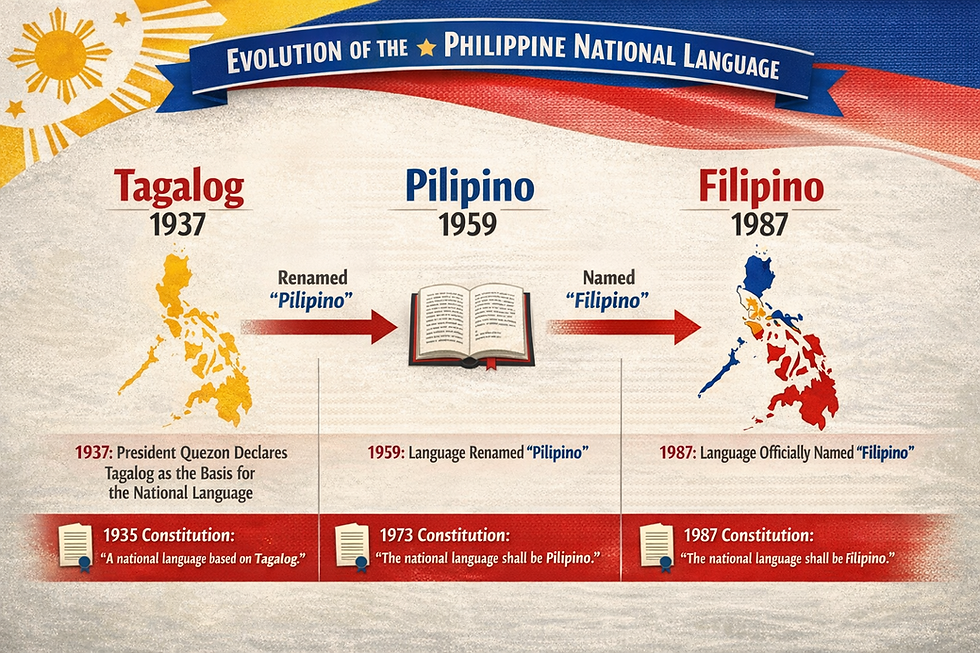
Tagalog was selected largely because it was already the lingua franca of Manila and surrounding provinces, had a rich literary tradition, and was spoken by an estimated 25% of the population. In 1939, it was officially renamed Wikang Pambansâ (National Language), and in 1959, rebranded as Pilipino to give it a more national – rather than ethnic – character. That change, however, didn’t convince everyone. Many non-Tagalog speakers, especially Cebuanos, felt their own languages were being pushed aside and deserved the same recognition.
The 1987 Constitution and the Birth of Filipino vs Tagalog
A major turning point came with the 1987 Constitution under President Corazon Aquino. It officially named Filipino — not Pilipino, and not Tagalog — as the country’s national language. More importantly, the constitution stated that Filipino should be “further developed and enriched” using words and expressions from other Philippine languages. The goal was to create a living, inclusive language that reflected the country’s full linguistic diversity.
In practice, however, Filipino remains structurally based on Tagalog. The grammar is essentially identical, and no substantial body of vocabulary has been systematically incorporated from other regional languages like Cebuano, Ilocano, or Hiligaynon. From a strictly linguistic perspective, as noted by Cornell University's Department of Asian Studies, "Filipino and Tagalog are varieties or dialects of the same language". Yet the constitutional distinction matters – it signals an aspiration toward linguistic unity that continues to shape education, media, and government communication today.
The Alphabet: From 20 to 28 Letters
One of the clearest differences between traditional Tagalog and modern Filipino is the alphabet. Back in 1940, the linguist Lope K. Santos introduced the Abakada, a 20-letter alphabet created specifically for Tagalog. It left out letters like C, F, J, Q, V, X, and Z because those sounds didn’t exist in native Tagalog words.
When Filipino was formally defined in 1987, the alphabet was expanded to 28 letters. It now includes the full English alphabet, plus Ñ from Spanish and the digraph Ng, which represents a single sound in Filipino. This change made it much easier to handle loanwords from Spanish, English, and other Philippine languages – which fits Filipino’s role as a more open, evolving national language. That’s why you now see letters like F in Filipino itself, and J and Z in everyday borrowed words like juice and zero.
Filipino vs Tagalog: Key Vocabulary Differences
If the grammar is basically the same, where do the real differences between Filipino vs Tagalog show up? Mostly in vocabulary – especially in how Filipino openly borrows from other languages, while traditional Tagalog tends to stick to native words.
Take something as simple as “chair.” In classical Tagalog, you might hear salumpuwit or upuan. In everyday Filipino, though, most people say silya, borrowed from the Spanish silla. The same thing happens with “dictionary.” The Tagalog term is talatinigan, but in real-life Filipino, diksyunaryo (from Spanish) is far more common. This isn’t unusual. Roughly 20% of Filipino vocabulary comes from Spanish, with English making up a large share as well — which explains why modern Filipino often sounds more global and flexible than traditional Tagalog.

Filipino also freely adapts modern English terms. Words like kompyuter (computer), selpon (cellphone), and drayber (driver) are standard in contemporary Filipino but wouldn't appear in classical Tagalog texts. This flexibility is precisely what the 1987 Constitution envisioned – a language that could grow with the times while remaining rooted in indigenous structures.
Why the Filipino vs Tagalog Distinction Matters for Localization
For anyone targeting the Philippine market, the difference between Filipino vs Tagalog isn’t just academic – it shapes how your content is received. Tone, formality, and even credibility can change depending on the language you choose. Using very formal or old-fashioned Tagalog can feel stiff to younger, urban audiences who are used to the more relaxed, mixed Filipino they hear in everyday media. On the other hand, too much English may feel out of place in more traditional or regional settings.
Officially, the government and school system use Filipino, so legal texts, policies, and public-facing documents should follow that standard. But in marketing, social media, and entertainment, you’ll often see Taglish – a blend of Filipino and English that has become the natural way many people in Manila and other cities communicate.
For localization professionals, this means going beyond grammar. You need people who understand how language actually works on the ground — when to sound formal, when to sound casual, and when mixing in English feels right. This is also where machine translation falls short. It can’t reliably switch between formal Filipino, everyday Taglish, and regional Tagalog styles. As I've discussed in my post on Danish AI translation limitations, AI tools often miss cultural context and register – and the same challenges apply to Filipino content.
Filipino vs Tagalog in Big Brand Marketing — Real World Examples
When big brands market in the Philippines, they rarely translate content into textbook Tagalog. Instead, most of the most successful campaigns use Filipino (often blended with English — Taglish) or language that feels Filipino in context because it connects better with real audiences.
Taglish in advertising
Many brands – both local and international – use Taglish, a natural blend of Filipino and English that people actually use in everyday conversation. Especially in urban and digital media, this mix works because it feels authentic and relatable to broad audiences.
How Major Platforms Treat Filipino vs Tagalog
In the digital world, even the biggest language platforms offer clues about how Filipino and Tagalog are understood in practice — especially when it comes to interface languages and language support.
ChatGPT
On OpenAI’s ChatGPT platform, users can choose “Tagalog” as a language setting in the interface and language preferences menu. That means you can ask ChatGPT to respond or generate output in Tagalog, which many users equate with Filipino in everyday use. Official documentation lists Tagalog in the supported languages list.
This is interesting because it shows a practical labeling choice: even global tech tends to use “Tagalog” when referring to the language option, likely because Tagalog is the ISO and technical label most developers default to, even if what people actually speak is Filipino.
Meta / Facebook & Instagram
Meta has been rolling out multilingual support for its AI assistant features across Facebook, Messenger, and Instagram in the Philippines. Recent updates highlight Tagalog support in Meta AI, meaning users in the Philippines can interact with the system in a language labeled “Tagalog.” But looking at the languages in the interface, it is listed as "Filipino."

FAQs about Filipino vs Tagalog
Is Filipino just another name for Tagalog?
Legally, no. Filipino is the official national language, designed to incorporate vocabulary from all Philippine languages. In practice, its grammar and core vocabulary are based on Tagalog.
Why was Tagalog chosen as the basis for Filipino?
Tagalog was already widely spoken in Manila, had extensive literature, and was the language of the revolutionary Katipunan movement – giving it political and cultural significance.
Should I localize content into Filipino or Tagalog?
For most business purposes, use Filipino. It's the official standard for government, education, and media. Specify "Filipino" in your project briefs to align with contemporary usage.
Is Filipino really spoken by all Filipinos?
No – while Filipino is the national language and widely taught in schools, not all Filipinos speak it as their first language. Many people grow up speaking regional languages like Cebuano or Ilocano.
Can people who speak Tagalog understand Filipino?
Yes, because Filipino is essentially the standardized, official form of Tagalog, native Tagalog speakers understand Filipino easily. In everyday use, most speakers don’t notice a meaningful difference.
Why do some people still call it Tagalog?
Because the grammar and core vocabulary of Filipino are based on Tagalog, many Filipinos use the terms interchangeably, and outside formal contexts, “Tagalog” is often the de facto label.
Contact LingClusive for a free consultation. I'm Jonathan Bentsen, the Danish freelance translator behind LingClusive. While my primary focus is Danish localization, I collaborate with multilingual teams across Asia and Europe. If you're navigating complex language questions for your global content strategy, get in touch – I'd love to help!


Comments